

Compliance with the debt brake
Current data on compliance with the debt brake, the outlook in the financial plans, and extraordinary expenditure and receipts.
The federal budget from a debt brake viewpoint
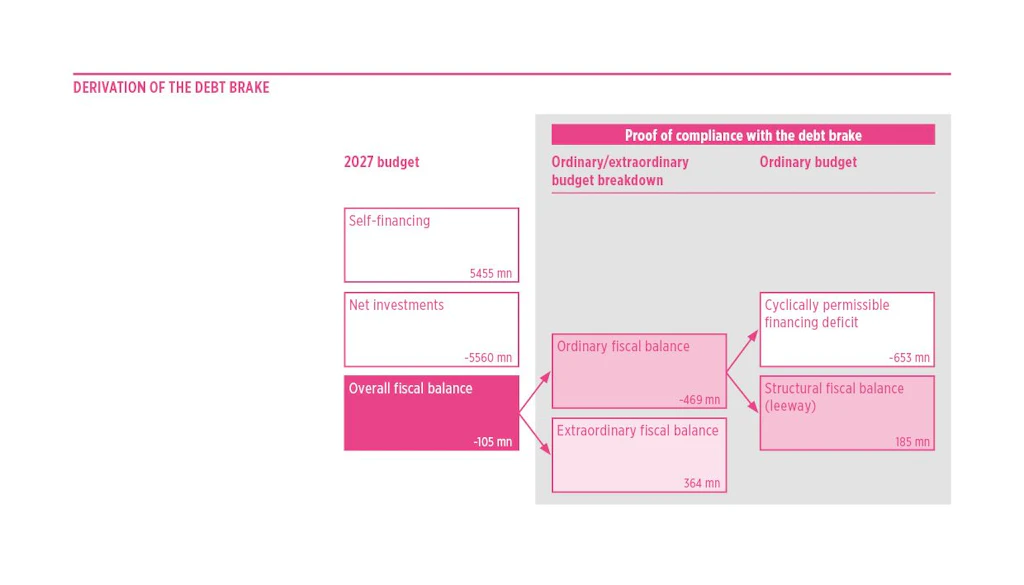
A financing deficit of -105 million is forecast for 2027 and is attributable largely to the ordinary budget (-469 mn). The ordinary financing deficit can be subdivided into a cyclical and a structural component.
In CHF bn
For 2027, the cyclical factor is 1.007, indicating economic capacity underutilization of 0.7%. The debt brake therefore permits a cyclical financing deficit of 653 million in the ordinary budget. Most of this is utilized in the 2027 budget, leaving leeway of 185 million (structural financing surplus). The debt brake requirements are thus met in the 2027 budget.
In exceptional cases such as the COVID-19 pandemic or in the case of the very high number of people from Ukraine seeking protection, the debt brake permits additional expenditure that does not fall under the restriction for ordinary expenditure. In 2027, for the first time in seven years, no extraordinary financing needs are projected. Expenditure related to people from Ukraine seeking protection will be fully included in the regular budget starting in 2027 (2026 budget: 470 mn in extraordinary expenditure). However, for the entire planning period, a profit distribution from the Swiss National Bank to the Confederation totaling 1 billion is anticipated, of which 333 million is classified as additional supplementary distributions.
Compensation account and amortization account
Both of these instruments for debt brake control statistics are updated based on the actual results in the financial statements. If there is a structural financing surplus in the ordinary budget, this is currently credited to the amortization account (FBA revision to reduce coronavirus-related debt; in force since February 1, 2023). Any structural financing deficit in the ordinary budget is debited to the compensation account.
Extraordinary receipts are credited to the amortization account, while extraordinary expenses are debited to it.
Data
Detailed data for longer periods are available under the following links: