
Annual result and net investments
A federal surplus or deficit is derived from current receipts minus current expenditure. Here, you can find the key information on the surplus/deficit for the year and on net investments.
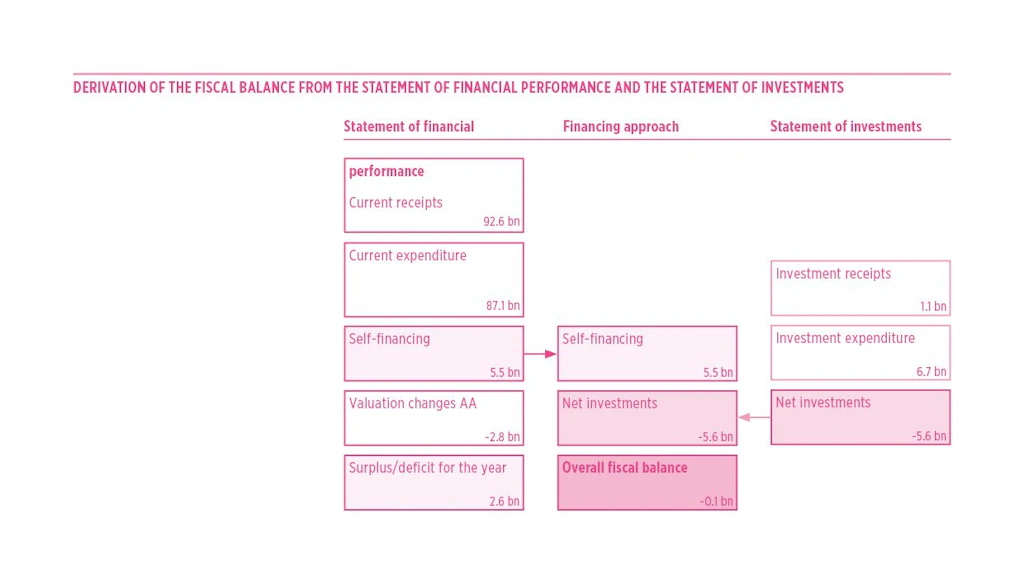
Derivation of the fiscal balance from the statement of financial performance and the statement of investments in CHF bn
Surplus/deficit for the year
The 2027 budget anticipates a surplus of 2.6 billion in the statement of financial performance (2026 budget: 1.8 bn). Current receipts (+3.3 bn) will grow at a faster pace than current expenditure (3.3 bn compared with +2.6 bn). The growth in current receipts is attributable primarily to the trend in direct federal tax for companies (+1.5 bn; profit tax direct federal tax), supplementary tax (QDMTT) (+0.8 bn) and value added tax (+0.6 bn).
The growth in current expenditure can be explained by higher expenditure for social welfare (+0.9 bn; especially for the 13th monthly AHV pension payment). Expenditure is up also in the finances and taxes task area (+1.3 bn). Owing to higher receipts from profit tax and supplementary tax, the cantons' share of receipts is to increase, and expenditure on fiscal equalization is also set to rise.
The financing contribution from the statement of financial performance – self-financing – is to rise to 5.5 billion (+0.7 bn). By contrast, the valuation changes regarding administrative assets, which concern essentially depreciation, amortization and unrealized gains on financial interests, will have a negative impact on the result (-2.8 bn).
Net investiments
Net investments (investment receipts less investment expenditure) remain virtually unchanged in 2027 at 5.6 billion. Investment expenditure shows a slight increase of around 55 million (+0.8%) in 2027, which is primarily attributable to higher investment in security. Investment receipts rise by 38 million in 2027, mainly due to higher dividend receipts.
Overall fiscal balance
In the 2027 budget year, self-financing from the statement of financial performance (difference between current receipts and expenditure) will not be sufficient to finance the planned net investments (difference between investment receipts and investment expenditure). A financing deficit of 0.1 billion is budgeted.
Total federal investments
Around half of the Confederation's investments are made using the federal budget. The other half originates from funds that are financed via the general federal budget. To obtain a comprehensive overview of investing activities, fund investments also have to be taken into account.
In 2027, total investments should reach 13.5 billion, or 14% of federal expenditure. Around 53% of this amount will go to transportation infrastructure, partly via the railway infrastructure fund (RIF), partly via the motorway and urban transportation fund (urban transportation share) and partly via the federal budget (deposit in the motorway and urban transportation fund for motorway construction). Additional funding will go from the grid supplement fund (GrSF) to promote renewable energies and energy efficiency.
Data
Detailed data for longer periods are available under the following links: