
E-bill, brief introduction
E-billing enables the digital and automated transmission of invoice data to the Confederation. Invoices can either be emailed as a PDF file or be submitted as a structured dataset via a service provider. The Confederation processes the data electronically, which avoids manual logging errors and accelerates the process.
All invoices for the Confederation must be submitted electronically. This e-billing requirement for suppliers saves time and costs, reduces paper consumption and speeds up processing. Small procurements are exempt from this requirement.Fate i conti con noi – ma elettronicamente!
Bill us electronically
Instead of printing your invoice and posting it to the Federal Administration, send your invoice data electronically to an e-bill service provider. You can save time and money – we will process your invoices swiftly and seamlessly. Suppliers can submit invoices as structured e-bills or as PDFs via various channels.
More information on:
Submitting e-bills to the Confederation
Receiving e-bills from the Confederation
If you have a question about a specific invoice, please contact the Shared Service Center Finances: e-rechnung@efv.admin.ch.
Proportion of e-billing exceeds 90%
The Confederation currently receives more than 90% of its invoices electronically. Since the federal government obliged its suppliers to submit electronic invoices, the proportion of e-bills has risen steadily and now stands at just over 90%. With a total volume of around 750,000 invoices per year, this corresponds to approximately 687,000 e-bills. The obligation does not apply to all invoices, as small procurements are exempt.
How e-billing works
With e-bills, all necessary invoice data is transmitted electronically from the biller to the bill recipient. This paperless process allows the information to be processed electronically at the recipient's end without it having to be imported manually into the systems. The workflow is shown in the diagram below and compared with the traditional process:
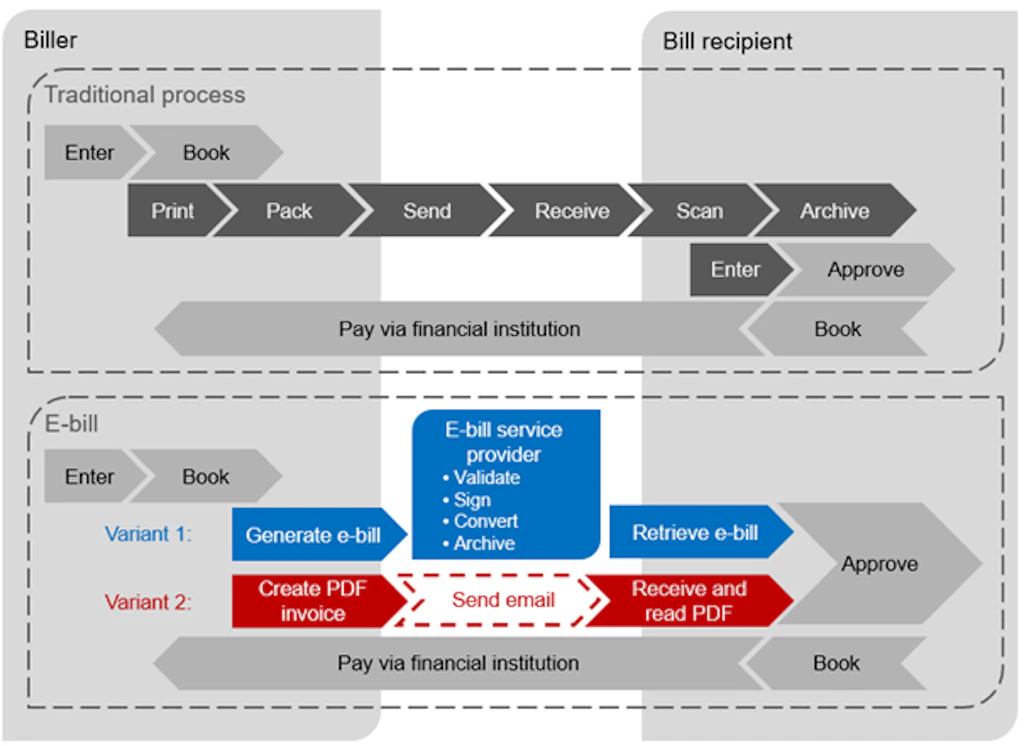
An e-bill can either be sent as a PDF file via email or be submitted as a structured dataset via a service provider. The recipient receives the e-bill and processes it electronically. The structured dataset can be imported directly, whereas the PDF file must be scanned. The e-bill is not paid until it has been approved by the bill recipient via his/her financial institution.
External links
- Forum for the promotion of business-to-business electronic invoicing: www.swissdigin.ch
- The eCH association promotes eGovernment standards: www.ech.ch
- Everything you need to know about the Unique Business Identification Number: www.uid.ch
- GS1 – The Global Language of Business: www.gs1.ch